Gender and Family Studies

Gender and Family Studies

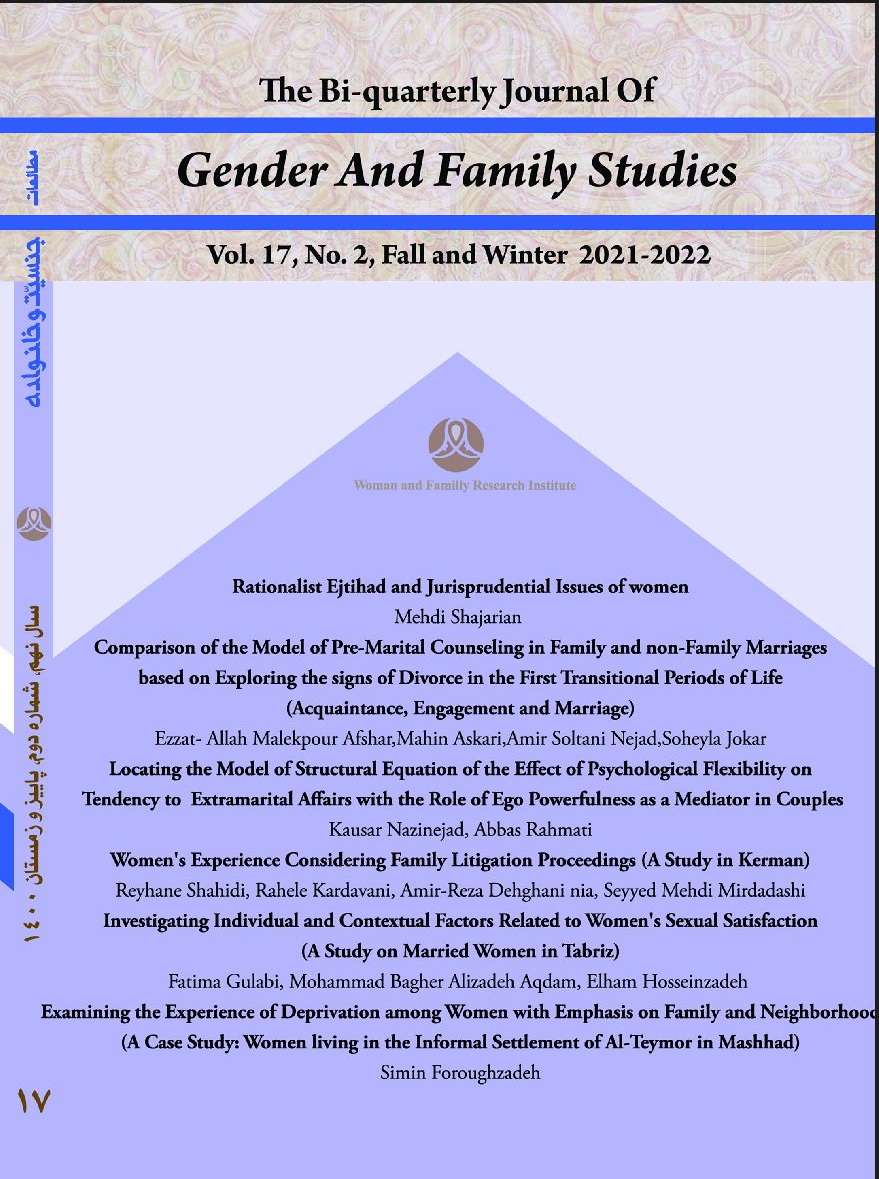
Locating the Model of Structural Equation of the Effect of Psychological Flexibility on Tendency to Extramarital Affairs with the Role of Ego Powerfulness as a Mediator in Couples

Document Type : Original Article

Authors
1 Student in M.A, Department of Psychology, Faculty of Literature and Human Sciences, Shahid Bahonar University of Kerman
2 Associate Professor, Department of Psychology, Faculty of Literature and Human Sciences, Shahid Bahonar University of Kerman
Abstract
This study aims to explain the effect of psychological flexibility on the tendency to extramarital relationships with the role of ego powerfulness as a mediator in couples. The current research was based on a correlational research and locating the model of structural equation type. The statistical population in this research included couples in Birjand. The sampling method was the accessible type and the number of samples included 192 couples (384 individuals). Questionnaires applied for collecting data from the sample groups included: Whatley's Extramarital Affairs Attitude Questionnaire (2006); Dennis and Vander Wal Questionnaire of Cognitive Flexibility (2010); Besharat Ego Powerfulness Scale (2016). Structural equation model (SEM) was used for statistical analysis of the collected data. According to the findings, the direct effect of psychological flexibility on the tendency to extramarital affairs, the direct effect of psychological flexibility on ego powerfulness, and the direct effect of ego powerfulness on tendency to extramarital affairs were confirmed. In addition, the indirect effect of the psychological flexibility variable through ego powerfulness on the tendency to extramarital affairs has been confirmed (P<0.01). Therefore, psychological flexibility and ego powerfulness have many practical implications in the research fields, etiology, and treatment of extramarital affairs.
Keywords

  1. باباخان‌زاده، سهیلا و پروین احتشام‌زاده و زهرا افتخار صعادی و سعید بختیارپور و احمد علی‌پور؛ «اثربخشی درمان فراشناختی با تأکید بر کارکردهای اجرایی مغز بر سندرم شناختی توجهی و حس انسجام خود در مبتلایان به اضطراب»؛ فرهنگ مشاوره و روان‌درمانی، ش۱۰ (۳۸)، 1398، ص195-۲۲۰.
  2. بادان فیروز، علی و اسحق رحیمیان بوگر و احمدعلی ناجی و محمدرضا شیخی؛ «تنظیم شناختی هیجان در دانشجویان: نقش پیش‌بین قدرت ایگو و سازمان شخصیت»؛ مجلة دانشگاه علوم پزشکی قم، ش۱۱ (۸)، 1396، ص37-46.
  3. بشارت، محمدعلی؛ «بررسی ویژگی‌های روان‌سنجی مقیاسی استحکام من»؛ گزارش پژوهشی، دانشگاه تهران، 1386.
  4. پورعلی‌بابا، بهزاد؛ «مقایسة شیوه‌های مقابله‌ای دانشجویان با توانمندی من بالا و پایین در مواجهه با استرس و ناکامی»؛ پایان‌نامة کارشناسی‌ارشد، انستیتو روان‌پزشکی تهران، 1381، ص18-25.
  5. سیدعلی‌تبار، سیدهادی و مجتبی حبیبی و مینو پورآوری؛ «بررسی روایی و پایایی مقیاس نگرش به روابط فرازناشویی»: فصلنامة پژوهش و سلامت، ، ص42-53.
  6. سیوندیان، مولود و محمدعلی بشارت و مجتبی حبیبی عسگرآبادی و علی مقدم‌زاده؛ «نقش تعدیل‌کنندة استحکام من در رابطه بین سبک‌های دلبستگی و سطوح سازگاری زوجین»؛ سلامت اجتماعی، دورة‌ 3، ش1، 1394، ص41-51.
  7. شاره، حسین و مریم اسحاقی ثانی؛ «نقش پیش‌بین شخصیت بامدادی ‌شامگاهی، انعطاف‌پذیری شناختی و تنظیم شناختی هیجان در رضایت زناشوییِ زنان میان‌سال»؛ مجلة روان‌پزشکی و روان‌شناسی بالینی ایران، ش۲۴ (۴)، 1397، ص384-399.
  8. شاره، حسین و اعظم فرمانی و اسماعیل سلطانی؛ «بررسی اعتبار و روایی پرسش‌نامة انعطاف‌پذیری شناختی (CFI-I) در بین دانشجویان دانشگاه ایرانی»؛ روان‌شناسی بالینی، ش2 (1)، 1393، ص43-50.
  9. صداقت‌خواه، عاطفه و ساره بهزادی‌پور؛ «پیش‌بینی کیفیت روابط زناشویی بر اساس باورهای ارتباطی، ذهن‌آگاهی و انعطاف‌پذیری روان‌شناختی در فرهنگ ایرانی»؛ اولین کنفرانس بین‌المللی فرهنگی: آسیب‌شناسی روانی و تربیت، تهران: دانشگاه الزهرا، 1396.
  10. کاوه، سعید؛ روان‌شناسی بی‌وفایی و خیانت: شناسایی، بررسی و تحلیل بی‌وفایی و خیانت همسران؛ تهران: سرای اندیشه، 1388، ص48-52.
  11. کچویی، محسن و علی فتحی آشتیانی؛ «نقش رضایت شغلی و نیرومندی‌های من»؛ مجلة طب نظامی، ش۱۵ (۱)، 1392، ص17-24.
  12. مهین‌ترابی، سمیه و محمدعلی مظاهری و علی صاحبی و سیدولی‌الله موسوی؛ «تأثیر آموزش‌های شناختی - رفتاری بر تعدیل انتظارات غیرمنطقی، بلوغ عاطفی و نارضایتی زناشویی در زنان»؛ مجلة علوم رفتاری، ش۲ (۵)، 1390، ص127-133.
  13. میکائیلی، نیلوفر و سعید رحیمی و مهرناز صداقته؛ «نقش الگوهای ارتباطی خانواده، ساختار انگیزشی و انعطاف‌پذیری روان‌شناختی در پیش‌بینی طلاق هیجانی زوجین»؛ آسیب‌شناسی، مشاوره و غنی‌سازی خانواده، ش7، 1397، ص1-16.
  14. Baucom, D.H. & D. KSnyder & K. C; Gordon, Helping Couples Get Past the Affair: a Clinician’s Guide; New York: Guilford Press, 2009.PP.118-128.
  15. Bond, F. W. & S. C. Hayes & R. A. Baer & K. M. Carpenter & N. Guenole & H. K. Orcutt & R. D. Zettle; " Preliminary Psychometric Properties of the Acceptance and Action Questionnaire–II: A Revised Measure of Psychological Inflexibility and Experiential Avoidance"; Behavior Therapy, 2011, v.42 (4), pp.676-688.
  16. Brinkborg, H. & J. Michanek & H. Hesser & G. Berglund; "Acceptance and Commitment Therapy for the Treatment of Stress Among Social Workers: A Randomized Controlled trial"; Behaviour Research and Therapy, 2011, v.49, 6–7: pp.389–398.
  17. Dennis J. P. & J. S. Vander Wal; " The Cognitive Flexibility Inventory: Instrument Development and Estimates of Reliability and Validity"; Cognitive Therapy and Research, 2010, v.34 (3), pp.241-253.
  18. Eilenberg, T. & L. Kronstrand & P. Fink & L. Frostholm;" Acceptance and Commitment Group Therapy for Health Anxiety – Results from a Pilot Study"; Journal of Anxiety Disorders, 2013,27, 5, pp.461–468.
  19. Flaxman, P. E. & F.W. Bond; "A Randomised Worksite Comparison of Acceptance and Commitment Therapy and Stress Inoculation Training"; Behaviour Research and Therapy, 2010,48, 8. pp.816–820.
  20. Fricker J.; Predicting Infidelity, "The Role of Attachment Styles, Lovestyles, and the Investment Model‌ [Thesis]"; Swinburne University of Technology, Hawthorn, Australia: 2006.PP.86-93.
  21. Glass, S. P., & T. L. Wright; "Reconstructing marriages after the trauma of infidelity", In W. K. Halford & H. J. Markman (Eds.); Clinical handbook of marriage and couples interventions, 1997, pp. 471–507.
  22. Hoffmann, D. & L. Halsboe & T. Eilenberg & J. Jensen & L. Frostholm; "‌A Pilot Study of Processes of Change in Group-Based Acceptance and Commitment Therapy for Health Anxiety"; Journal of Contextual Behavioral Science, 2014, v.3, 3, pp.189–195.
  23. Kashdan T. B & J. Rottenberg; "Psychological Flexibility as a Fundamental Aspect of Health"; Clin Psychol Rev, 2010, v.30 (7), pp.865-878.
  24. Katz, A. M. & S. J. Czech & S. Orsillo;" Putting Values into Words: An Examination of the Text Characteristicsof Values Articulation"; Journal of Contextual Behavioral Science, 2014, v.3 (1), pp.16-20.
  25. Markstrom, C. A. & S. K. Marshal;" The Psychosocial Inventory of ego Strengths: Examination of Theory and Psychometric Properties"; Journal of Adolescence, 2007, v.30, pp.63–79.
  26. Moitra E. & B. A. Gaudiano;" A Psychological Flexibility Model of Medication Adherence in Psychotic-Spectrum Disorders"; Context Behav Sci, v.5 (4), 2016. pp.252-257.
  27. Omarzu, J. et al; "Motivations and Emotional Consequences Related to Engaging in Extramarital Relationships"; Int J Sex Health, 2012, v.24 (2), pp.154-162.
  28. Shackelford, T. K. & A. Besser & A. T. Goetz; " Personality, Marital Satisfaction, and Probability of Marital Infidelity"; Journal of Individual Differences Research, 2008, v.6, pp.13-25.
  29. Wiederman M. W & C. Hurd; "Extradyadic Involvement During Dating"; Journal of Social and Personal Relationships, 1999, v.16 (2), pp.265-274.
  30. Wallace D. P. & L. M. McCracken & K. E. Weiss & C. Harbeck-Weber; "The role of Parent Psychological Flexibility in Relation to Adolescent Chronic Pain: Further Instrument Development "; J Pain, 2015, v.16 (3), pp.235-246.