Gender and Family Studies

Gender and Family Studies

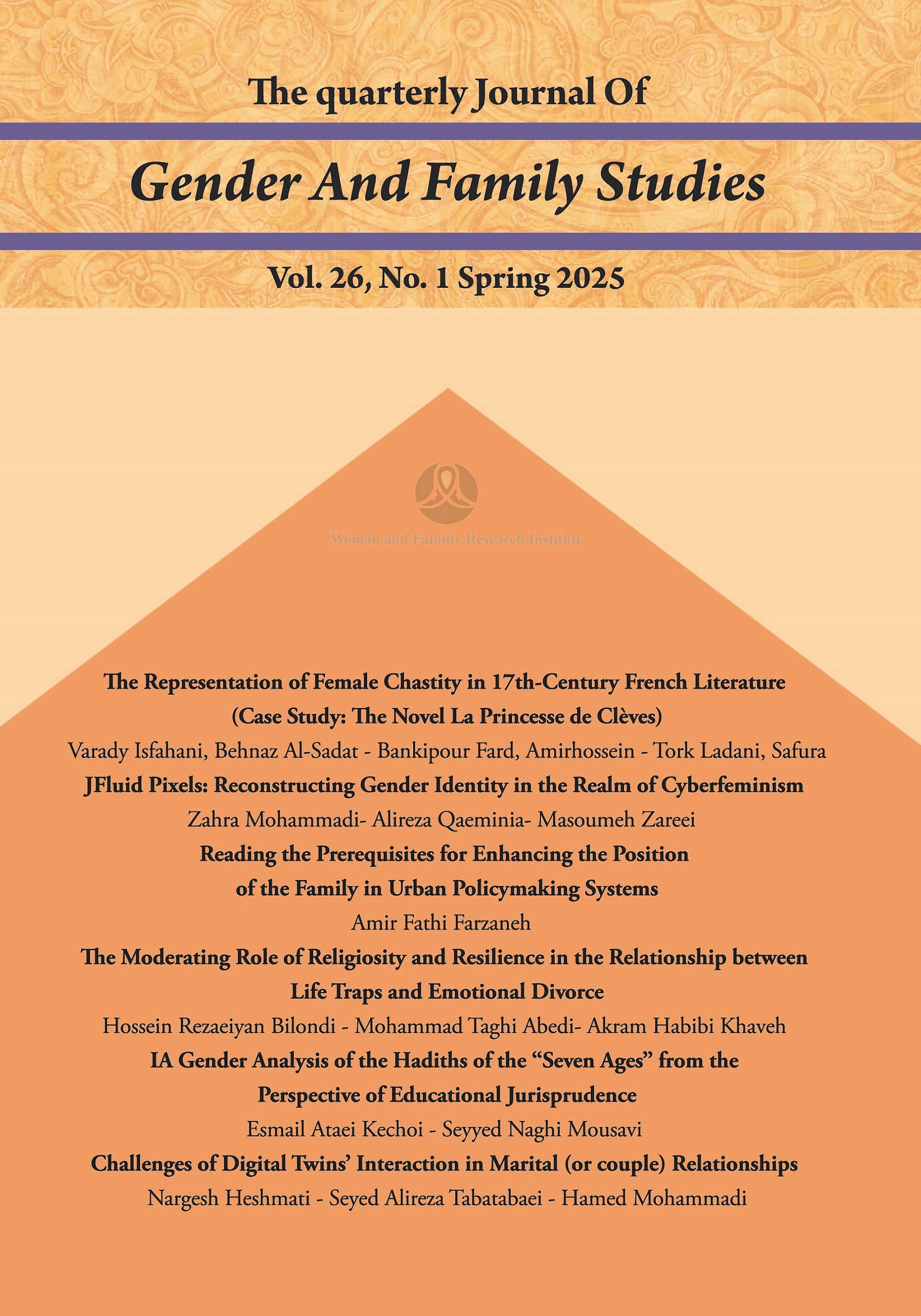
Presentation of chastity of women in 17th century French literature ( the subject of study : the novel Princess Cleves)

Document Type : Original Article

Authors
1 Isfahan University, Faculty of Literature, Department of Ahl al-Bayt Education
2 University of Isfahan - Faculty of Foreign Languages ​​- Department of French
Abstract
Chastity is among the moral virtues rooted in human nature, which has historically served as a source of perfection and flourishing for women across various societies. Focusing on 17th-century French literature and the novel La Princesse de Clèves as one of the most significant literary works reflecting the culture of French society in that century, specifically, a narrative centrally concerned with the theme of female chastity and the mechanisms and strategies for its preservation, this study seeks to examine the representation of the concept of chastity in this work.
This research was conducted within a qualitative framework, utilizing thematic analysis as its method. The domain of the study is 17th-century French literature, specifically the novel La Princesse de Clèves by Madame de Lafayette. To validate the processes of data collection and analysis, as well as the obtained results, conventional validation approaches for qualitative research appropriate to the current study were employed, including the use of an external auditor and thick description.
The findings of the research indicate that the concept of female chastity in La Princesse de Clèves is represented around five organizing themes, including self-restraining character, chastity-oriented maternal upbringing, pious disposition, duty-bound orientation, and distancing. These are encompassed by the overarching theme of "Chastity as Duty-Boundness." In essence, the core theme of chastity in this novel is commitment, duty, and obligation towards oneself and the other, and its semantic pattern is formulated around this concept and its associated network of themes. Duty-boundness signifies an individual's duty, commitment, and responsibility towards oneself and others. Here, too, in relation to the story's main character as the unit of analysis, the defining principle of chastity and the strategies for its preservation revolve around duty and obligation towards oneself and the other (spouse). From this perspective, chastity is viewed as a duty and obligation that an individual has towards themselves, others, and society.
In this novel, we encounter two forms of duty [towards self and towards other] in relation to chastity. Duty towards oneself encompasses themes such as self-restraining character and pious disposition. Duty towards the other encompasses the theme of distancing. In reality, an individual, first in line with the duty and obligation they have towards themselves, cultivates a type of character whose prominent feature is self-restraint—or, in other words, the control of carnal desires—and also adopts a pious disposition in their personal and social life. Both themes express a type of obligation towards the self. An obligation or duty that places the individual on the path of chastity. This also holds true for duty and obligation towards the other. The main character of the novel feels a sense of duty towards preserving social honor and, simultaneously, feels a duty-bound commitment towards her previous marital life, which again has a socio-discursive nature. Based on this, she deems it her duty to define, at a more social level, the same strategies she had defined for herself in a state of self-imposed obligation, in order to preserve chastity. She adopts strategies such as withdrawal, interaction based on passivity, and engagement based on reason to maintain chastity with others.judicial intervention. In conclusion, the article underscores the urgent need for comprehensive review and reform of Iran’s family laws. Such reform should encompass: re-conceptualizing the nature of the marriage contract beyond transactional frameworks; revising provisions related to the wife’s right to withhold marital duties (ḥaqq al-ḥabs); aligning legislation with contemporary socio-cultural transformations in family life; and promoting non-judicial mechanisms for dispute resolution. The ultimate goal of these reforms is to enhance family resilience, protect the institution of the family from structural erosion, and mitigate the weakening effects of the current legal framework on familial stability.
Keywords

Alexander, R. D.; The Biology of Moral Systems; New York:
Aldine de Gruyter, 1987.
 Attride – Stirling, J.; "Thematic Networks: an Analytic Tool for Qualitative Research"; Qualitative Research, v.1, n.3, 2001, pp.385-405.
 Braun, V. & V. Clarke; "Using Thematic Analysis in Psychology";
Qualitative Research in Psychology, v.3, n.2, 2006, pp.77-101.
 Brill, L. W.; (1971). "Chastity as Ideal Sexuality in the Third Book of The Faerie Queene"; Studies in English Literature, 1500-1900, 1971, pp.15-26.
 Buss, D. M.; "The Evolutionary Psychology of Human Social
Strategies"; in S. F. D. Gilbert & G. Lindzey (Eds.); Handbook of
Social Ppsychology
; Chicago, IL: McGraw-Hill, 1998, pp.3-38.
 Creswell, J. W., & D. L. Miller; "Determining Validity in Qualitative Inquiry"; Theory Into Practice, 2000, v.39, n.3, pp.124-130.
 DeTurk, S.; "Conflicting Desires: Sexuality, Chastity, and the Representation of Lucretia in Sixteenth-Century Venetian Painting (Italy) "; Ph.D Thesis, Bryn Mawr College, 2001.
 Gilmore, D. D.; Honor and shame and the unity of the
Mediterranean
; Washington, DC: American Anthropological Association, 1987.
 Lindisfarne, N.; (1998). "Gender, Shame, and Culture: An Anthropological Perspective"; in P. Gilbert (Ed.); Shame: Interpersonal Behavior, Psychopathology and Culture; New York: Oxford University Press, pp.246-260.
 Madame de La Fayette; "La Princesse de Clèves"; Ed. Garnier-Flammarion, Paris, 1966.
 Mahalingam, R.; "Beliefs about Chastity, Machismo, and Caste Identity:
A Cultural Psychology of Gender"; Sex Roles, n.56, 2007, pp.239-249.
 Porter, J.; "Chastity as a Virtue"; Scottish Journal of Theology, v.58, n.3, 2005, pp.
 Roy, O.; Chastity in Ancient Indian Texts: Precept, Practice, and Portrayal; Taylor & Francis, 2022.
 Weisfeld, G. E.; (1993). "Social Status and "alues in Traditional Arab
Cultures"; in E. Lee (Ed.); Comparative Biosocial Analysis; Westport, CT: Praeger, 1993, v.1, pp.75-97.
 Wikan, U.; Behind the veil in Arabia: Women in Oman;
Baltimore: Johns Hopkins University Press, 1982.